Google Trends just hit a 5-year peak for Miami real estate.
But as a dual-licensed NY/FL broker, I’m seeing something the headlines are missing.
This isn’t a frenzy.
It’s a shakeout.
1. The $1 Billion Reality Check
Over the last six months, nearly $1 billion has been deployed into Miami land acquisitions.
But the spread between winners and losers has never been wider.
The Ceiling
Institutional players just closed on $500M+ and $200M+ land sites in Brickell.
These are long-duration bets anchoring Miami’s future as a global financial hub.
The Floor
At the same time, the 1-acre 340 Biscayne site (former Holiday Inn) went to auction.
Despite a $175M asking price, it was taken back by the lender for $77M.
The takeaway:
This is the canary in the coal mine.
The long-term Miami vision is intact.
But capital markets are aggressively repricing over-leveraged and over-supplied projects.
2. The Global Pivot: London Is the New NYC
Everyone is waiting for a tidal wave of New Yorkers.
In reality, what I’m seeing is more disciplined:
a steady stream of “working wealth”, not a panic exodus.
The real surge right now?
London.
As UK tax pressure reaches historic levels, London millionaires have quietly become one of Miami’s strongest feeder markets—now representing nearly 10% of buyers in our newest ultra-luxury towers.
This isn’t emotional migration.
It’s capital redeployment.
3. 2026 Strategy: The Flight to Quality
When Fear, Uncertainty, and Doubt show up in urban cores, smart capital does one thing:
It moves toward scarcity.
Personally, I’m focused on high-barrier-to-entry neighborhoods that cookie-cutter supply can’t touch.
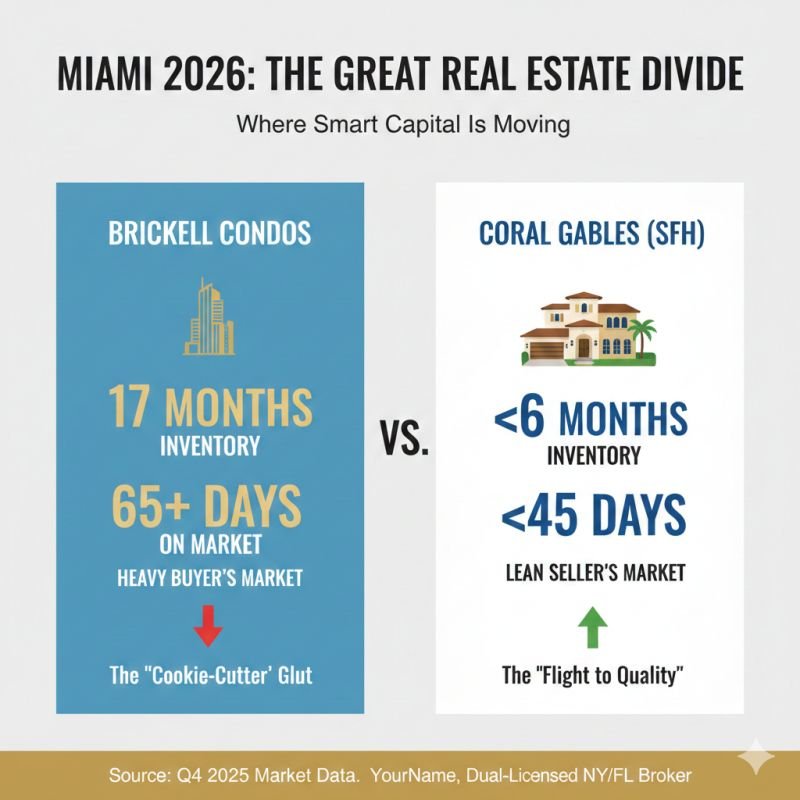
The data makes this obvious:
- Brickell: ~17 months of inventory
- Coral Gables: <6 months of inventory
That divergence matters.
Beyond the Gables, I’m watching Coconut Grove and Key Biscayne closely.
With Terra Group’s ultra-luxury Key Biscayne project launching in 2026, I expect absorption to be fast—driven by genuine exclusivity and limited alternatives.
These submarkets continue to show:
- faster absorption
- lower volatility
- real scarcity
That’s where long-term value compounds.
4. 2026 Prediction: Where the Stress Will Show
The softness in the generic 1-bedroom condo segment is real.
With ~17 months of inventory in Brickell condos (versus a healthy sub-6 months for Coral Gables single-family homes), I expect:
- 1–2 high-profile Downtown or Brickell projects
- to stall, restructure, or quietly change hands
- sometime in 2026
Velocity simply doesn’t exist for oversupplied product.
Capital is patient.
But it isn’t forgiving.
The Bottom Line
2026 isn’t about “buying Miami.”
It’s about buying the right asset.
If you want to dodge condo churn and position for real downside protection, start with absorption rates, not headlines.
If you want to walk through the data in Coral Gables, Coconut Grove, or Key Biscayne, let’s look at it together.
That’s where quality is quietly winning.